
-

-
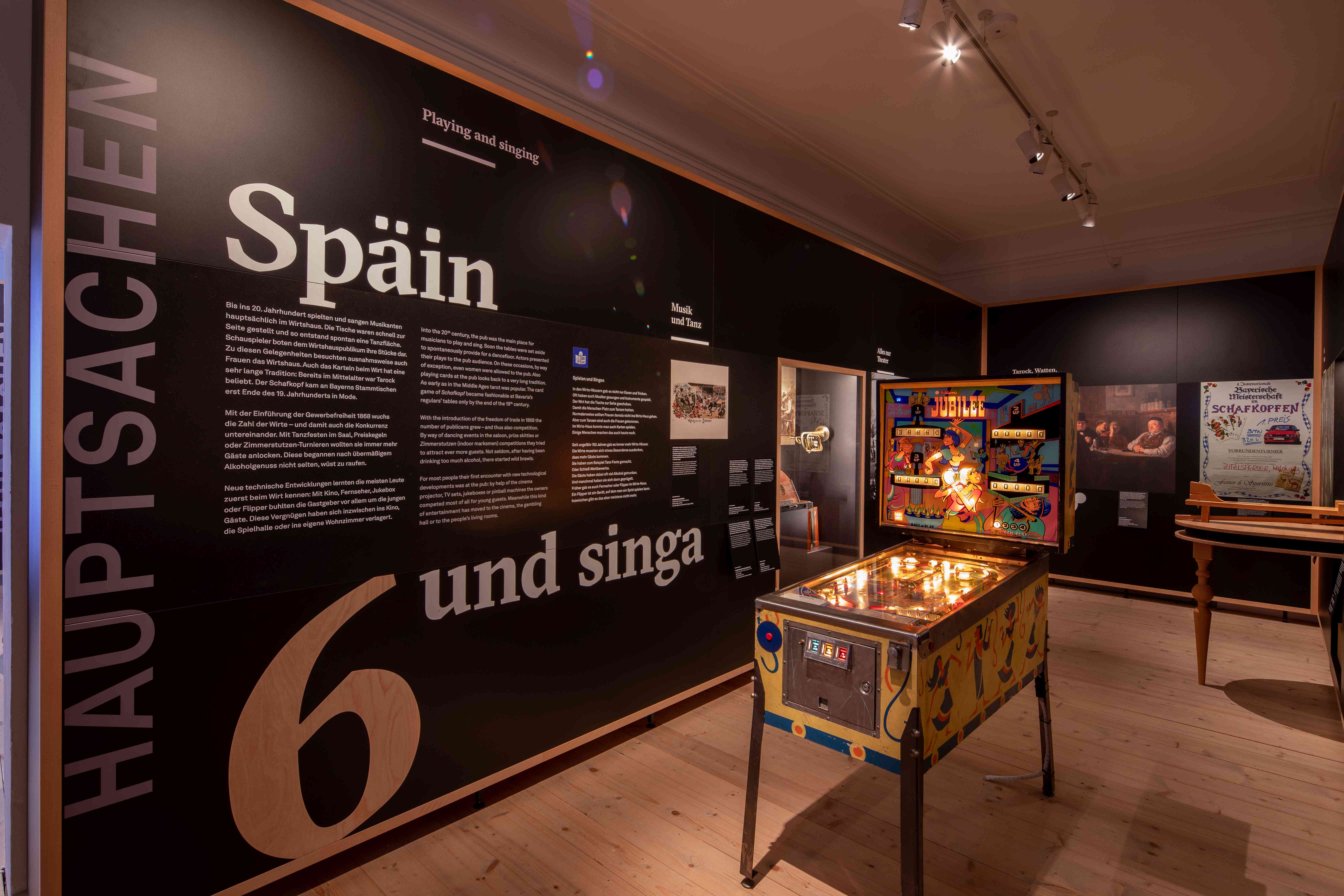
Impression aus der Wirtshaus-Ausstellung im Kloster Aldersbach © Haus der Bayerischen Geschichte | Foto: Herbert Rath -
Never built dream:
Gabriel von Seidl's Spatenkeller
Around 1900, beer palaces were springing up like mushrooms in Munich. In order to keep up with the competition, the Spatenbrauerei commissioned the renowned architect Gabriel von Seidl to build a contemporary new Spatenkeller on Bayerstraße in 1898.
The largest hall
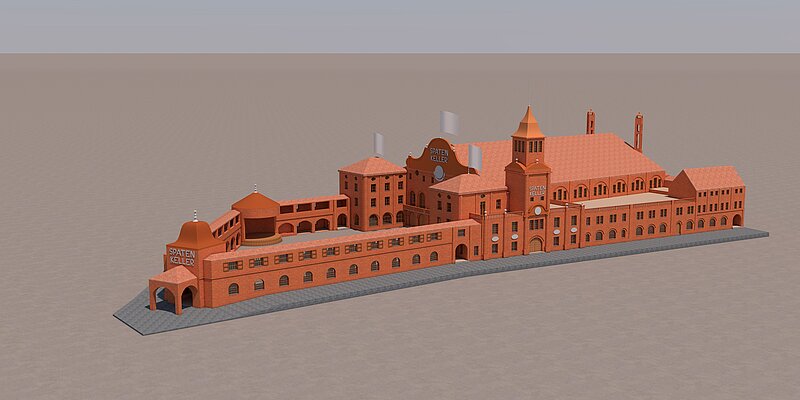
Seidl's design, which was never built, included the largest hall in Munich: at just over 1,500 m², the floor space was slightly smaller than that of the hall in the Münchner-Kindl-Keller on Rosenheimer Straße. However, with a 650 m² gallery on the second floor, the Spatenkeller hall would have offered considerably more space for additional guests. Seidl's building would have been a new highlight in beer palace architecture.
Planning permission for Gabriel von Seidl's designs was granted in 1903. The Munich city archives still hold the plans today. Presumably as a result of the economic crisis between 1900 and 1902, however, the large-scale project was never realized.
Brought to life thanks to university cooperation
As part of a final thesis with Prof. Dr.-Ing. Gerd Maurer at the Deggendorf Institute of Technology, Sven Rosenberger designed the building on the computer using the original plans. Seidl's vision is thus coming to life for the first time in 120 years.
Animation zum Spatenkeller, © Technische Hochschule Deggendorf (Prof. Dr.-Ing. Gerd Maurer, Sven Rosenberger)
An impressive architectural model of the Spatenkeller, created from Seidl's original historical plans and 3D-printed at the Deggendorf Institute of Technology / Technology Campus Cham under the direction of Prof. Dr.-Ing. Wolfgang Aumer, can be admired in the Bavarian exhibition "Wirtshaussterben? Wirtshausleben!" between April 30, 2022 and December 11, 2022.